Antenor
 TELECOM & DATA AT SCALE
- Teramanager, massive-scale CDR storage: Siemens (TOT Thailand), Movicom-BellSouth
- Traffic monitoring and analysis for ISPs
- Unconventional high-volume databases, text search engines, IoT
Founder & CEO
"I am the bridge between complex business goals and bare-metal engineering." The person who translates what a board needs into systems that actually ship, scale and survive production.
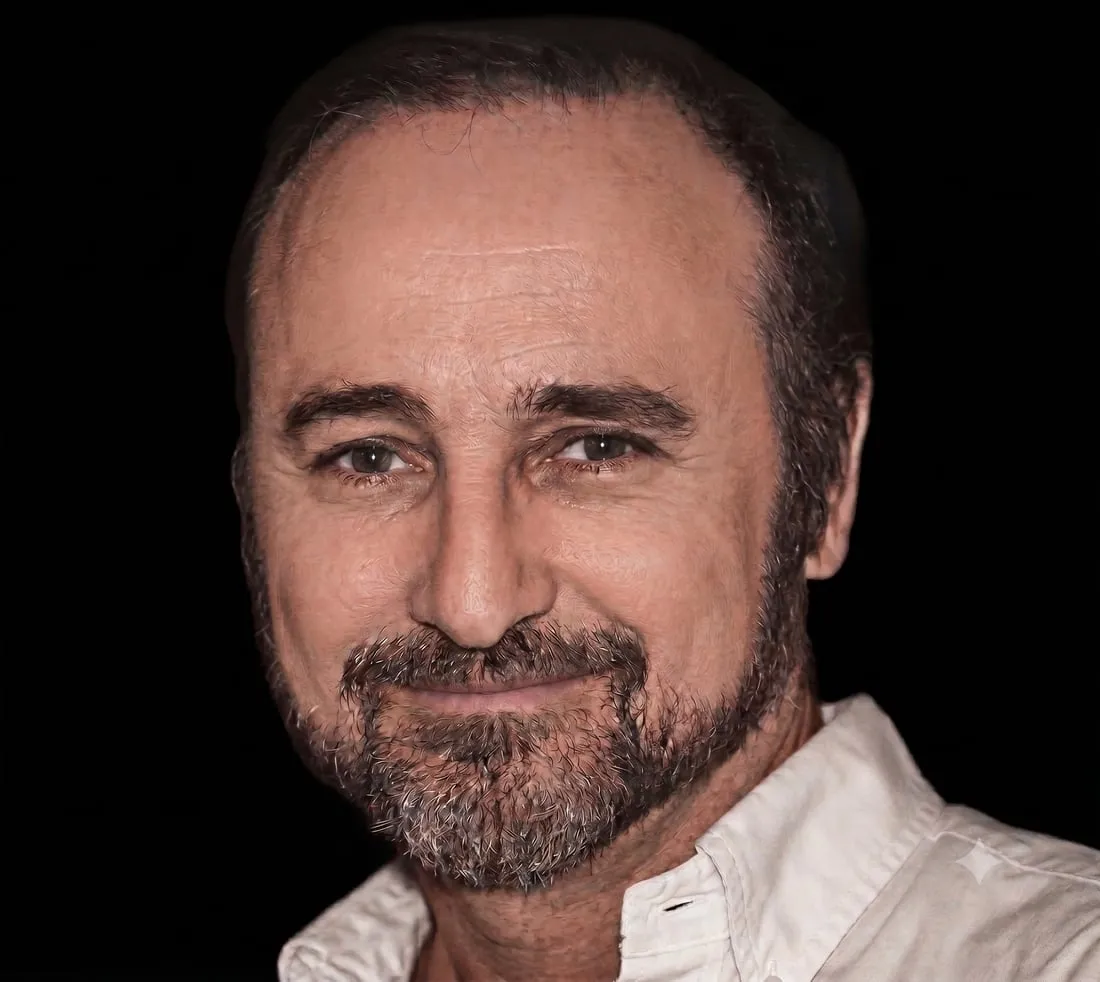
Antonio Velázquez Bustamante is the founder and CEO of Antenor, an AI, machine learning and custom software firm operating between Miami, FL and Buenos Aires. He describes his role simply: he is the bridge between complex business goals and bare-metal engineering, the person who translates what a board needs into systems that actually ship, scale and survive production.
Over a career spanning more than 25 years, Antonio has led stable engineering teams building mission-critical software for some of the most demanding organizations in the Americas and beyond. His teams designed and operated Teramanager, a massive-scale call-detail-record storage solution deployed for telecom operators including Siemens (TOT Thailand) and Movicom-BellSouth; built the digital directory platforms behind Páginas Amarillas Argentina, Telefónica de Chile and Telelistas Brazil; and delivered a phonetic search engine covering registered trademarks across Latin America.
He built web-crawling and market-intelligence systems for MercadoLibre, OLX and DeRemate, e-marketing products for Pfizer, Sanofi and Merck, software for IBM and Hewlett-Packard printer bundles, digital solutions for Deutsche Bank Latin America Capital Partners, and the Crime Map for the Ministry of Justice of the City of Buenos Aires. The portfolio ranges from unconventional high-volume databases and text search engines to IoT, mobile and enterprise web platforms.
Today his focus is applied artificial intelligence. He holds a Master's in Data Science from the University of Buenos Aires (School of Exact and Natural Sciences). The through-line is unchanged: rigorous engineering, measurable outcomes, and technology chosen because it works, not because it trends. Antonio leads every Antenor engagement personally, backed by a senior team he has worked with for years.
Flagship projects across 25+ years, grouped by the problems they solved.
Current hands-on work. Not slideware.
Storm nowcasting built on Argentina's SINARAME radar network and GOES-19 satellite data (ABI and GLM), including radar quality control and tracker validation. Reaches a Critical Success Index of 0.39 at +60 minutes, beating the S-PROG baseline; published as an EarthArXiv preprint.
Machine learning trading models identifying trends in Nasdaq equities, validated with strict out-of-sample discipline and offered to the public through Asesores Inteligentes, a supervised roboadvisor with SIPC-insured US custody.
Hands-on evaluation of retrieval architectures, published as "Does GraphRAG Actually Help? Spoiler: Sometimes Yes, Sometimes It Lies to You".
AI agents for smart manufacturing and predictive maintenance: lightweight ML models deployable in six to eight weeks for small and mid-size manufacturers, plus AI applications in healthcare device manufacturing and supply chain.
Most-read essays on applied machine learning and optimization — the methods behind the work. More on Medium.
THE OTHER ANTENOR
This company has two namesakes. One is the elder of Troy, who counseled the city with the authority that only experience gives — the half of our work that is judgment, not code. The other is a robot.
In the 1970s, Carlos Iraldi — the luthier and instrument-builder behind the Argentine ensemble Les Luthiers — built a robot he named Antenor and brought it on stage, long before robotics or automation meant anything to anyone outside a lab.
Iraldi and his wife, Amanda Pellegrino, a researcher at CONICET, lived on the top floor of the building where I grew up. I spent hours of my childhood in their home, where the two of them patiently answered the endless questions of a curious kid. That is where my curiosity about how things work — the one that turned into a career in engineering and AI — actually started.
Naming the company after both of them is deliberate. Half the work is knowing what to build, and why. The other half is having the nerve to build it before it is obvious. I learned the second half on that top floor.
One session with a senior engineer. We'll tell you whether AI pays for it, and what it takes to ship.